Our Stage 1 tune for the BEW is designed to deliver a healthy increase in power and torque while maintaining the reliable, predictable characteristics that make the BEW such a popular platform. It provides stronger acceleration and improved overall performance without requiring additional hardware modifications, making it an excellent choice for a stock or otherwise lightly modified BEW.
Stage 1 is well suited to daily-driven BEWs looking for a meaningful improvement in performance without moving into a more extensive hardware build. The additional torque is particularly noticeable in everyday driving, giving the vehicle more usable power when accelerating onto the highway, climbing hills, or passing slower traffic.
If you've been thinking about adding some power to your TDI, Stage 1 is a great option, providing noticeable gains in acceleration and improved passing and overtaking power when you need it.
As with any performance tune, the vehicle should be mechanically healthy and properly maintained before tuning.
For BEW owners looking for a little more than Stage 1, our Stage 1.5 tune takes performance up another notch with a modest increase in power and torque. The result is stronger acceleration and a more noticeable push when getting up to speed, with additional power available for highway merging and passing.
Stage 1.5 is still designed with everyday use in mind and does not require any additional hardware modifications. It works well on stock or lightly modified vehicles, giving owners an easy way to get a bit more from their BEW without making major changes to the vehicle.
If Stage 1 sounds close to what you're looking for but you want that extra step in performance, Stage 1.5 is a great middle ground.
Our Stage 2 tune for the BEW pushes the stock turbo further, delivering a stronger increase in power and torque for owners looking to get more performance from their TDI. Compared with Stage 1 and Stage 1.5, Stage 2 provides a more noticeable improvement in acceleration and overall power, with additional torque that makes highway merging, passing, and overtaking considerably stronger.
This is the highest stage we offer for the BEW that's designed for the factory turbo. It does not require additional hardware modifications, making it a straightforward way to get the most from the stock-turbo setup while retaining the factory turbocharger. It's a great option for owners who want to maximize the performance of their BEW without moving away from the factory turbo setup.
The factory BEW turbo can experience boost creep at higher RPM, with the risk increasing at Stage 2 power levels. Modifying the stock intake or exhaust while retaining the factory turbo is not recommended, as increased airflow can worsen boost creep.
We strongly suggest you check for boost creep via data logging or by installing a boost gauge. Boost should not exceed 18 PSI (1.24 Bar) except briefly during initial acceleration.
Stage 4 takes the BEW into a completely different level of performance, moving beyond the limits of the factory turbo and into a larger-turbo setup. This tune delivers a substantial increase in power and torque, with the added airflow and boost capability of the larger turbo opening up considerably more room for the BEW to perform.
A 3-bar MAP sensor and upgraded clutch are required for Stage 4, while an exhaust upgrade is recommended. The result is a much stronger and more capable vehicle, with significantly improved acceleration, stronger pull through the RPM range, and a level of performance that goes well beyond what the stock turbo can offer. With the right turbo setup, Stage 4 transforms the character of the BEW, giving it the stronger top-end and sustained power that make a larger-turbo build so rewarding. Stage 4 power figures may vary slightly depending on the turbo selected, but the VNT-17 provides an excellent foundation for this setup.
If you've reached the limits of what your stock turbo is able to offer on your BEW, Stage 4 is the logical next step. As with any performance tune, the vehicle should be mechanically healthy and properly maintained before tuning.
* Genuine Garrett or BorgWarner turbos are strongly recommended: The vast majority of rebuilt or hybrid turbos are not optimally calibrated. VNT-type turbos are naturally more complex than the wastegated turbos commonly found in gas cars, which means there is more room for error when it comes to actuator setup and boost control. We do not recommend other-brand turbos. However, if you are willing to put in a potentially significant amount of work logging boost and recalibrating the vacuum actuator and/or stop screw, reasonable results may be possible from an aftermarket or rebuilt turbo.
** The VNT-17/22 was a popular turbo that was previously used with our BEW performance development and also runs well with Stage 4: It was originally created by an official Garrett distributor and produced very consistent results. However, the performance upgrade over a regular VNT-17 is marginal, and the turbo was discontinued years ago due to parts availability issues. "17/26" or "GT1752v" aftermarket options may exist today and are similar in size to the classic VNT-17/22, but we have seen more inconsistent boost control with these turbos due to lower-quality actuator and stop-screw setups. We recommend a brand-new, genuine Garrett or BorgWarner VNT-17 with Stage 4 for rock-solid, OEM+ boost control.
For cars with automatic transmissions: Stage 4 can still be used. We do not offer tunes for automatic transmission computers (unless it is a DSG-equipped 2004–2006 New Beetle TDI). These automatic transmissions are known to have less-than-stellar reliability, even at the factory 100 hp output. Although we have many customers running a full Stage 4 ECU tune without issues, we can offer a reduced-torque Stage 4 tune if you want to reduce the risk to the transmission. Please ask our team about this option.
Upgrade
Requirement
A "VNT-17" turbo (see table below)
Required
3 bar MAP sensor
Required - unless you want to run 21 PSI or lower boost with a stock MAP sensor - please contact us
Clutch Upgrade (manual)
Exhaust Upgrade
Recommended (for quicker boost build-up and lower exhaust gas temperature)
Turbo
Alternative Turbo Name
Max. Boost
Source
Note
Garrett GT1749V
"VNT-15"
18 PSI (1.24 Bar)
90HP 1.9L TDI
Limited to Stage 2 tune!
Garrett GT1749VA
"VNT-17"*
22 PSI (1.51 Bar)
Euro 130HP 1.9L PD TDI
Please ask us for a Stage 4 tune that sets 22 PSI instead of 24 PSI.
Borg-Warner S7
Garrett GT1749VB
24 PSI (1.65 Bar)
Euro 150HP 1.9L PD TDI
This is the most common "VNT-17" turbo and you can use the Stage 4 tune from our InstaTune server.
Garrett Distributor custom build
"VNT-17/22"**
26 PSI (1.79 Bar)
Hybrid turbo
Pick Stage 5 if you want to run 26 PSI and if you have enough fueling to support that boost. Otherwise, you can comfortably run Stage 4 set at 24 PSI or lower with this turbo.
Stage 4 Clutch Saver delivers the same larger-turbo performance upgrade as Stage 4, but with a reduced-torque tune designed specifically for builds where clutch capacity is a concern. It retains the stronger power and broader performance of the Stage 4 setup while limiting peak torque in the lower RPM range, where the highest torque output can put the greatest load on the clutch.
A 3-bar MAP sensor and upgraded clutch are required for Stage 4 Clutch Saver, while an exhaust upgrade is recommended. The lower-torque strategy is intended to reduce the chance of clutch slip while still allowing the larger turbo to deliver strong acceleration and sustained power through the RPM range.
Stage 4 Clutch Saver is particularly well suited to manual-transmission BEWs where the owner wants the performance of a larger-turbo setup without pushing as much torque through the clutch. Automatic transmission owners may also consider this option to reduce transmission stress; as we do not offer tunes for the automatic transmission on these vehicles (aside from 2004-2006 New Beetles equipped with a DSG).
For cars with automatic transmissions: The Stage 4 Clutch Saver tune can be used to reduce the torque load on the automatic transmission. We do not offer tunes for the automatic transmission computers, so this option only reduces torque output from the ECU tune and does not change the transmission's shift strategy or torque limits. Automatic transmissions are known to have less-than-stellar reliability, even at the factory 100 hp output, so the reduced-torque Stage 4 tune may be a worthwhile option for owners looking to reduce transmission stress.
Required, unless you want to run 21 PSI or lower boost with a stock MAP sensor. Please contact us
Recommended
Recommended for quicker boost build-up and lower exhaust gas temperature
Custom Tuning starts at $1999. To get a more accurate cost on your custom tune, please create a ticket and tell us more about your build, and your specific modifications.
If you feel that our existing tune offerings will not work for your application or your intended use, you can request Custom Tuning. Custom Tuning must be requested through our Tickets, and you must provide vehicle information as well as hardware (upgrades) information. Once submitted, our team of calibrators will evaluate your request and determine if Custom Tuning can achieve your goals and if they are able, your Tune Request will be accepted.
Custom Tuning requires heavy participation from the Customer, either through an Authorized TZ Dealer or the Customer themselves. TuneZilla Calibrators will require that the vehicle has access to dyno time when needed, and data logging is required. If you are not comfortable with data logging, and if you may not be able to access a facility with a dyno (many facilities will rent dyno time) custom tuning may not be possible for you.
Custom Tuning vs. Off The Shelf Tuning
We understand that our end users have varying driving styles and build purposes, which is why we offer revisions on all of our Off-The-Shelf tunes. By offering Custom Tuning to our customers, we can be sure you are getting the most out of your vehicle with your specific parts upgrades. Our OTS (off-the-shelf) maps are tested in house with as many variables as possible to ensure even if you don’t want to customize your tune, your vehicle’s OEM sensors and adaptations will still be able to optimize our tunes to your region’s fuel and most bolt-on upgrades. Tune Revisions are not the same as Custom Tunes. See our Terms and Conditions for our re-tune policy (section 4b)
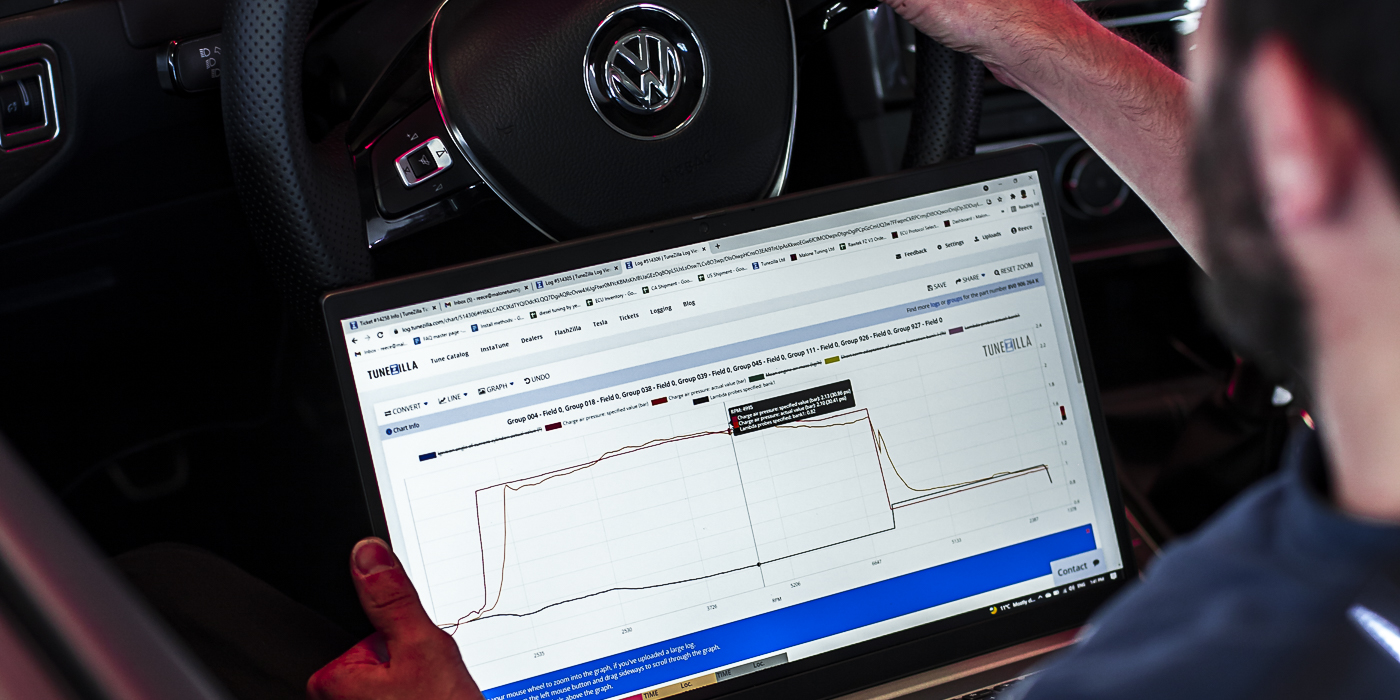
We believe it’s important for our customers to understand what is happening inside their engine so they can make informative decisions. Our LOG VIEWER automatically generates your vehicles data log .csv files into easy to read graphs which can then be viewed by our Calibrators to find areas of optimization on your vehicle. Not only can this data be used to optimize your tunes, but a lot of troubleshooting and diagnosing can be done by comparing requested data to actual data at a glance.
In many cases, custom tuning is not required. If you are unsure if you will benefit from a Custom Tune, you can reach out to our team and upload data logs for them to examine.
Custom Tuning
Fuelling upgrades (Injectors, Rail Pressure Sensors, etc)
Supported
Turbo Upgrade - Hybrid or larger
Hardware Removal
Immobilizer Delete (Engine Swap)