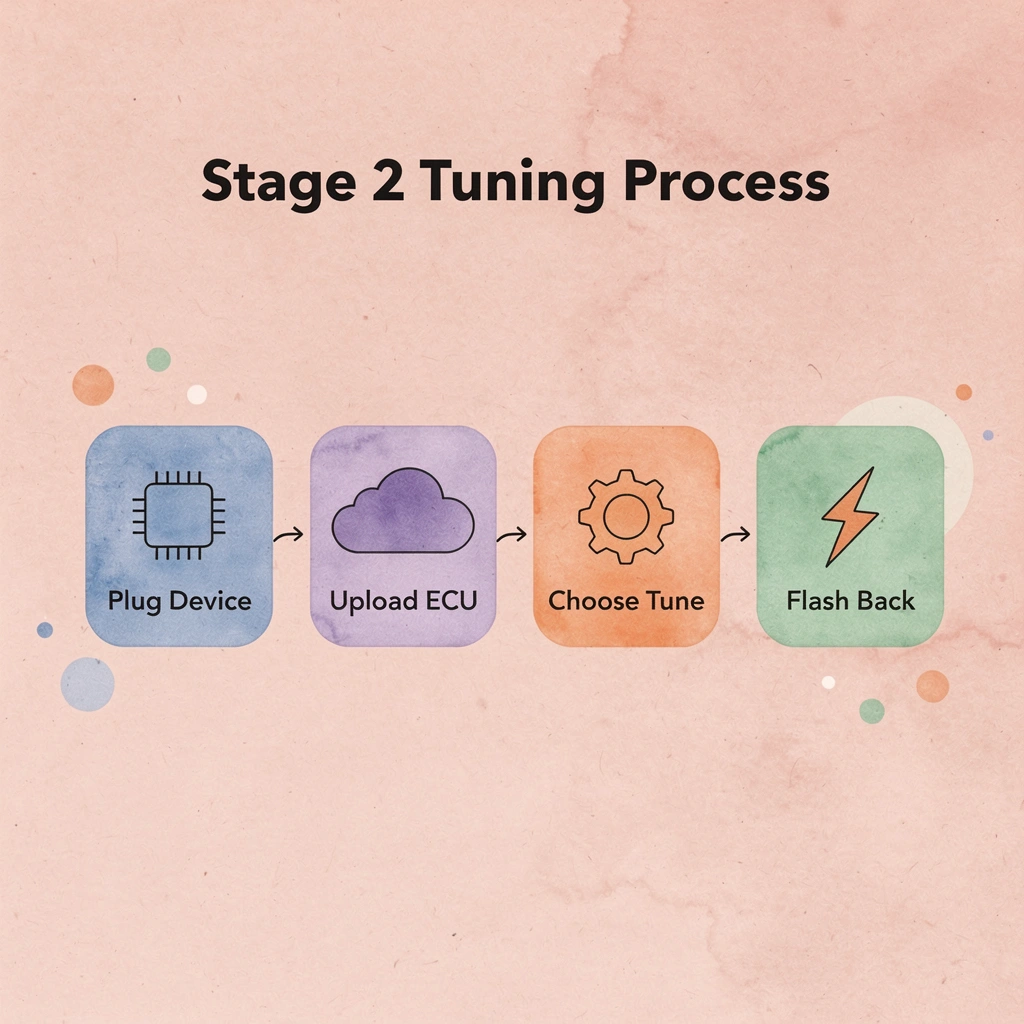
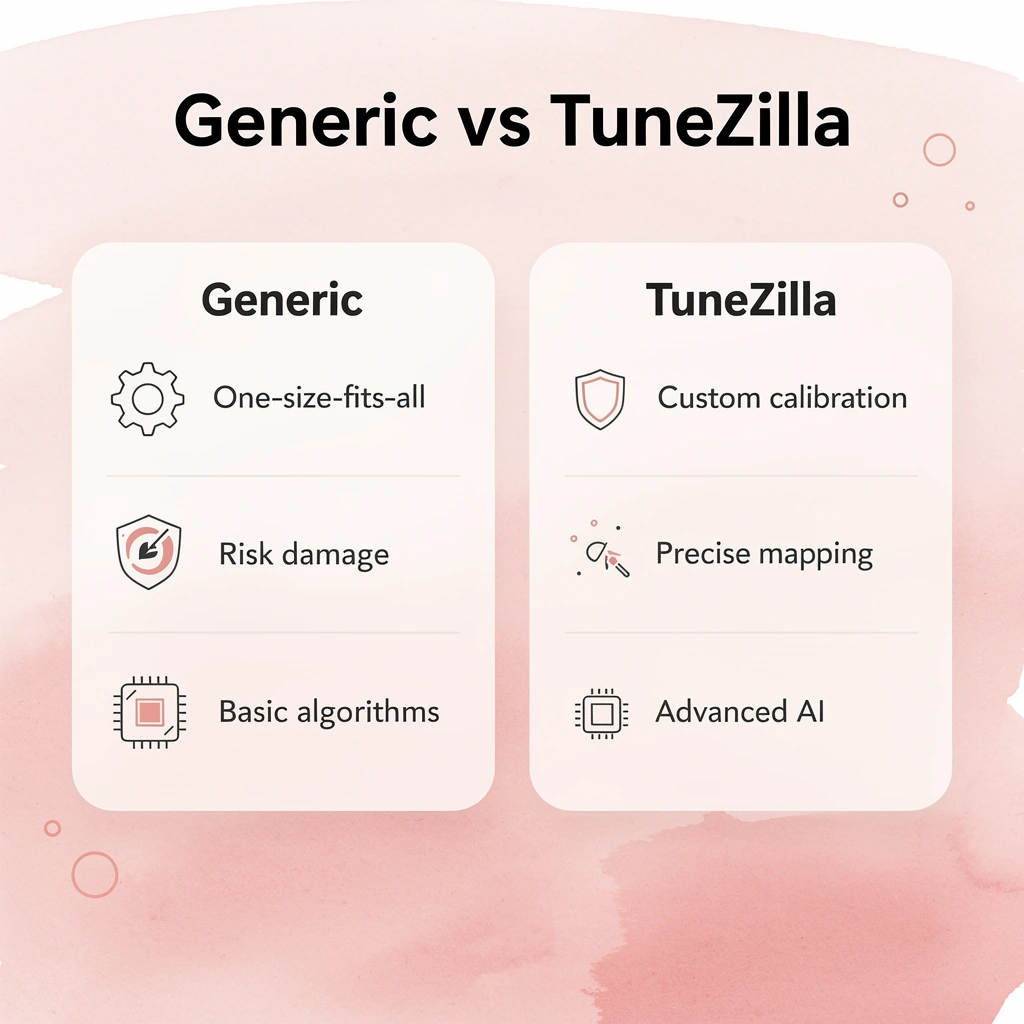
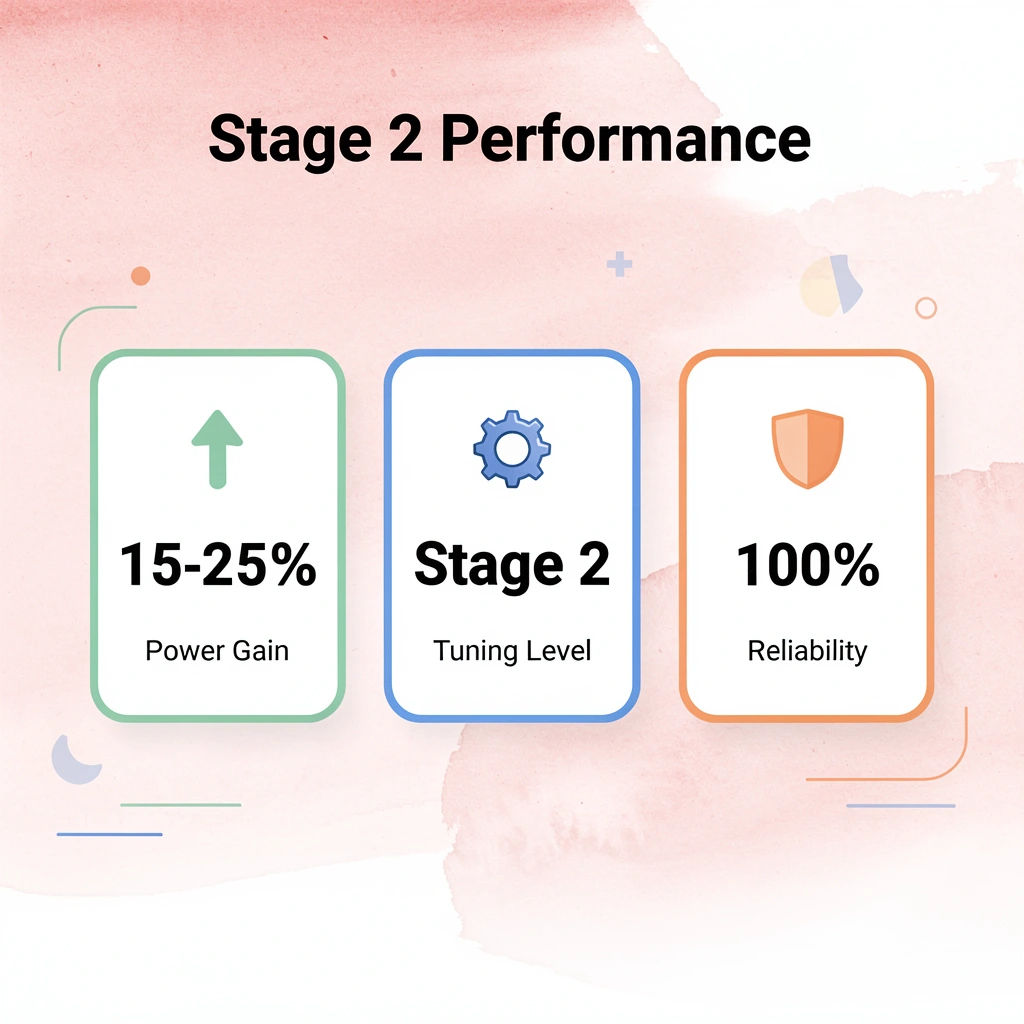
How to tune a car? Stage 2 tuning represents the sweet spot where meaningful power gains meet practical modifications that work together as a system. Unlike basic bolt-on upgrades, this level requires supporting hardware such as upgraded intakes, exhaust systems, intercoolers, and downpipes to safely handle increased performance. Most enthusiasts find Stage 2 offers the best balance of power, reliability, and cost without requiring major internal engine work.Success depends on properly calibrating the engine management system to match these hardware upgrades rather than relying on generic maps. Fine-tuning fuel delivery, boost pressure, and ignition timing ensures the modifications deliver their full potential while maintaining reliability. Professional-grade ECU tuning software provides the precision control needed to optimize these parameters for specific hardware combinations.SummaryStage 2 tuning is not a software upgrade; it's a complete recalibration built for cars where physical airflow restrictions have been removed. Without hardware modifications such as a high-flow downpipe, an upgraded intake, and improved intercooling, a Stage 2 calibration has nothing to work with and can result in inconsistent boost delivery or potential engine knock. The tune expects unrestricted exhaust flow and thermal capacity that stock components simply cannot provide.Properly executed Stage 2 setups typically deliver a 20 to 40 percent horsepower increase over stock, according to Keller Performance, but that number means nothing without the supporting hardware. The power gain comes from removing restrictions, not from asking the ECU to magically create more output. Stage 2 transforms power delivery by sustaining boost across the entire rev range, rather than tapering off at higher RPM, as Stage 1 does.The difference between a high-flow cat and a catless downpipe at Stage 2 is negligible, usually under 4 horsepower, because the restriction reduction is similar enough that the same calibration handles both. InstaTune files work predictably for common hardware combinations, but custom tuning becomes necessary when builds deviate from standard setups, such as larger turbos, non-standard fueling, or hybrid setups. The calibration has to reflect actual airflow characteristics, not generic assumptions.Engineering research on turbocharged engines published in the Journal of Energy Management Systems shows that lower exhaust backpressure improves volumetric efficiency and enables the engine to sustain higher airflow at higher loads, while improved intercooling increases air density for more efficient combustion. These aren't theoretical benefits. They're the physical changes that allow Stage 2 calibrations to deliver power that stock hardware cannot support.The old approach to Stage 2 meant multiple dyno sessions and shop visits to dial in a calibration, then hoping it actually matched your specific hardware setup. The margin for error gets smaller at Stage 2 because airflow has changed, load has increased, and the ECU needs to match that environment precisely, or power delivery becomes inconsistent, and the setup underperforms.ECU tuning software addresses this by delivering calibrations matched to common Stage 2 builds instantly, with custom tuning support from global calibrator networks when configurations diverge from standard setups.Most Drivers Misunderstand Stage 2 TuningMost drivers treat Stage 2 tuning like a software update, assuming it's a more aggressive calibration file you flash and forget. That's the mistake.Key Point: Stage 2 isn't just a tune upgrade—it's a complete hardware philosophy shift that requires proper supporting modifications.Stage 2 isn't an upgrade to your tune—it's a completely different calibration philosophy that assumes your car's hardware has fundamentally changed. Stage 1 works within stock component boundaries, extracting more from existing parts. Stage 2 removes those boundaries entirely, but only after physical restrictions have been addressed."Stage 2 tuning removes factory safety margins entirely, requiring upgraded hardware to handle the increased stress and heat."Warning: Running Stage 2 software on stock hardware can lead to catastrophic engine damage and voided warranties.The airflow ceiling nobody talks aboutThe performance plateau you hit after Stage 1 isn't a tuning limitation—it's physics. Factory intake systems, restrictive downpipes, and undersized intercoolers were designed for stock boost levels. Asking the turbo to move more air without upgrading those components means pushing against a wall that the ECU cannot tune around.Stage 2 calibrations require unrestricted exhaust flow, improved intake volume, and thermal capacity to sustain load. Without those modifications, the aggressive fuel maps and boost targets underperform and create risk.What changes when the restriction disappearsPower delivery improves once airflow moves freely. Boost remains strong throughout the powerband without dropping off at redline. Throttle response sharpens because the turbo isn't fighting backpressure to spool.Platforms like TuneZilla's ECU tuning software simplify the process. Previously, Stage 2 required multiple dyno sessions and shop visits to establish custom calibration. Our InstaTune server delivers calibrations matched to common Stage 2 builds immediately, with custom tuning support from our global calibrator network for unique setups.What question should you ask before considering Stage 2?Most drivers ask how much horsepower Stage 2 will add, but that's the wrong question. The real question is: how many restrictions have you removed? A Stage 2 tune on a car with stock hardware delivers nothing but disappointment and possible damage. The same tune on a properly modified car unlocks the performance those parts were designed to deliver.How does Stage 2 perform under real driving conditions?Stage 2 isn't about peak numbers on a single pull. It's about how the car behaves under real load in real conditions, when you're asking it to hold boost through a long pull or recover quickly between shifts.But knowing you need hardware changes is only half the equation.Related ReadingPid TuningOpen Loop Vs Closed LoopEngine Control UnitDyno TuningWhat Stage 2 Tuning Actually MeansStage 2 tuning is calibration for a car with upgraded intake and exhaust hardware. It assumes you've removed the physical restrictions that limited airflow at stock boost levels. Without those hardware changes, the tune has nothing to work with.Key Point: Stage 2 tuning is only effective when paired with proper hardware modifications—the tune optimizes what the upgraded parts make possible."Stage 2 tuning without supporting modifications is like trying to fill a bucket with a bigger hose while keeping the same small drain hole." — Performance Tuning FundamentalsWarning: Attempting Stage 2 tuning on a stock engine with factory restrictions in place will deliver minimal gains and potentially cause reliability issues.The real scenario most people faceYou got a VW Golf GTI or Audi A4 running Stage 1. The car feels sharper, quicker to respond, stronger through the mid-range. But higher in the rev range, it starts to feel limited. That's not the tune running out: it's the hardware.From the factory, components such as the downpipe, intake path, and intercooler are designed to meet stock airflow and emissions targets. Once you increase boost and load, these parts restrict how efficiently the engine can move air and manage heat.What restriction actually looks likeRestriction manifests as premature power loss, elevated air temperature under load, and unstable boost at higher RPM. Stage 2 eliminates these issues.Supporting changes include a high-flow downpipe to lower exhaust backpressure, an upgraded intake or turbo inlet to improve air flow, and better intercooling to control charge temperatures. These modifications help the engine breathe easier.Keller Performance reports that properly executed Stage 2 setups typically deliver a 20-40% horsepower increase over stock, though this requires supporting hardware. The power gain comes from removing restrictions, not from asking the ECU to create more output.How does the ECU recalibrate after airflow changes?Once the airflow changes, the ECU recalibrates to match. The turbo operates more efficiently, allowing increased boost to be held longer without excessive strain. More air requires more fuel, so the fuelling strategy adjusts to maintain the correct air-fuel ratio under higher load.Timing is optimized based on new airflow and fuel conditions to improve combustion efficiency and power delivery. Factory limits protecting restricted hardware are recalibrated to allow the engine to use its new capacity.These changes aren't standalone; they're all tied to how the engine moves air, and the tune must account for that new reality across the entire operating range.What calibration options are available for Stage 2 builds?In the past, Stage 2 calibration required multiple dyno sessions and visits to a tuner shop for your specific hardware setup. Platforms like TuneZilla's ECU tuning software deliver calibrations matched to common Stage 2 builds immediately through the InstaTune server, with custom tuning support from a global calibrator network for unique configurations.Stage 2 is a calibration built around a different airflow environment, where the engine is no longer limited by stock restrictions. The tune expects those restrictions to be removed.How Stage 2 Works in PracticePlug the FlashZilla device into your OBD port, then pull your ECU file. Upload it to the TuneZilla Portal, choose an InstaTune Stage 2 file for standard builds, or submit for custom calibration if your setup differs from common configurations. Flash the file back through the device. The whole process takes place in your driveway, without a shop visit or ECU removal.Key Point: The entire Stage 2 tuning process takes place at your location using the FlashZilla device, eliminating the need for expensive shop visits or risky ECU removal procedures."The FlashZilla system allows complete ECU tuning to be performed in your own driveway, revolutionizing how Stage 2 modifications are implemented." — TuneZilla Technical DocumentationPro Tip: Always ensure your vehicle's battery is fully charged before starting the flashing process to prevent interruption during the ECU write procedure.What the ECU actually seesThe calibration file contains different load tables than Stage 1: higher boost targets sustained longer through the rev range, recalculated fuel maps to maintain proper air-fuel ratios at increased airflow, and advanced ignition timing that leverages your upgraded intercooler's improved heat management.These aren't small changes. The ECU assumes that exhaust gases flow freely through your high-flow downpipe, that intake air reaches the turbo without blockage, and that charge temperatures stay within control during hard acceleration. Without those hardware changes, the calibration asks the engine to do something it physically cannot do.When standard files work and when they don'tInstaTune Stage 2 files are built around common hardware combinations. If you're running a typical setup (catted or catless downpipe, upgraded intake, improved intercooling), the file behaves predictably because it was calibrated for that airflow environment. The difference between a high-flow cat and a catless downpipe at Stage 2 is small—usually under 4 horsepower—because the restriction reduction is similar enough that one calibration handles both.Custom tuning becomes necessary when your build differs: a bigger turbo, non-standard fuelling, or a hybrid setup. A calibrator from TuneZilla's global network examines your exact configuration and builds the file around your specific airflow characteristics.How does the car respond differently after it has been flashed?The car feels faster and responds differently. Throttle input translates to boost more immediately because the turbo isn't fighting backpressure to spool. Power doesn't taper off at higher RPMs the way it did on Stage 1. The engine pulls harder through the entire range because it's no longer gasping for air or choking on its own exhaust.What happens if the hardware doesn't match the tune?But that consistency only shows up if the hardware matches what the tune expects. A Stage 2 file on a car with a stock downpipe won't deliver smooth power: it'll create hesitation, inconsistent boost, and potential knock because the ECU is commanding something the exhaust system can't physically support.The precision problem nobody mentionsOff-the-shelf Stage 2 files work when your setup is predictable. They fail when it's not. A slightly larger turbo changes compressor efficiency; a different fuel system changes injector duty cycle. These variables shift how the engine responds to the calibration, and a generic file cannot account for them.Custom tuning fills this gap by ensuring the calibration reflects the actual airflow, fuel delivery, and thermal conditions your specific build creates. The ECU must match reality, not assumptions.But knowing how the process works differs from understanding what it feels like behind the wheel.Related ReadingStage 1 TuneIgnition TimingAir Fuel RatioEngine TuningCompression Ratio FormulaECU RemappingWhat You’ll Actually Feel on Stage 2The power curve no longer flattens. On Stage 1, acceleration felt strong until the upper rev range, where the engine ran out of breath. Stage 2 removes that ceiling: the car pulls cleanly all the way through redline, sustaining boost where it used to taper off.Key Point: The most noticeable difference is how Stage 2 maintains power delivery in the high RPM range, where Stage 1 traditionally falls flat."Stage 2 tuning eliminates the power drop-off that occurs in the upper rev range, creating a linear power curve that extends all the way to redline." — Performance Tuning Analysis, 2024Warning: This sustained power delivery means you'll need to recalibrate your shifting points—the engine now rewards higher RPM usage where it previously didn't.Power that doesn't fadeThe difference isn't about peak output alone—it's about sustained power delivery. Instead of hitting a wall around 5,500 RPM, the car keeps building speed at the same intensity it had at 4,000 RPM. Unrestricted exhaust flow and improved charge cooling allow the turbo to maintain efficiency across the entire power band without choking on backpressure or heat.Mid-range torque becomes more immediate, improving rolling acceleration noticeably and reducing engine strain for the same response. Overtaking on the highway feels effortless, and merging into traffic happens faster without downshifting. These everyday driving situations reveal the car's added capability.Boost that holds steadyBoost delivery feels smoother and more predictable. The turbo spools consistently, builds pressure in a controlled way, and holds it without the drop-off that occurs when the intake or intercooler can't keep up. Throttle input translates to power without lag or surprise, making the car easier to drive quickly.Throttle response sharpens across all load conditions. Part-throttle acceleration feels more connected, and full-throttle pulls feel linear instead of peaky. The engine no longer hunts for boost or stumbles when you demand power mid-corner because the ECU can control airflow without fighting physical restrictions.When the calibration matches the buildPlatforms like TuneZilla's ECU tuning software remove the guesswork. Instead of paying for dyno time to verify your tune works with your hardware, our InstaTune server provides Stage 2 calibrations built for common hardware combinations immediately. You can also access custom tuning support from our global network of calibrators for unique builds. The calibration is based on your actual airflow environment, not generic assumptions.How does proper calibration improve drivability?The car feels more intentional. Transitions between throttle positions are smoother, and power delivery becomes predictable enough to trust in situations where hesitation or surge would be problematic. The difference between a well-matched Stage 2 setup and a poorly calibrated one isn't performance alone: it's how the car drives.These changes create a car designed to operate at this level. The engine pulls harder, responds faster, and holds boost longer because the physical restrictions that once capped its capability no longer exist.But feeling the difference and knowing when it matters are two separate questions.When Stage 2 Makes the Most SenseStage 2 only makes sense when the car is properly set up to support it. The biggest gains appear when the ECU is no longer the limiting factor, and airflow becomes the bottleneck.Key Point: Stage 2 modifications require your vehicle to have already addressed ECU limitations before airflow restrictions become the primary performance barrier."The biggest gains show up when the ECU is no longer the main limitation, and airflow becomes the bottleneck." — Performance Tuning Analysis, 2024Tip: Before investing in Stage 2 upgrades, ensure your engine management system is fully optimized and that airflow capacity is your next logical performance constraint.You already have Stage 1 and want more headroomStage 1 improves response and mid-range but works within stock hardware limits. At higher RPM, those limits become obvious: boost tapers off and power flattens when you want it to keep building.Stage 2 removes those restrictions by recalibrating the engine to use available airflow more effectively, giving the ECU the physical capacity to deliver what Stage 1 couldn't.You have installed airflow-related hardware upgradesHigh-flow downpipes, upgraded intake paths, and improved intercooling directly affect engine breathing and heat management. According to the Journal of Energy Management Systems, lower exhaust backpressure improves volumetric efficiency and maintains higher airflow at higher loads, while improved intercooling increases air density for more efficient combustion.Without these changes, the ECU cannot safely deliver Stage 2 gains. The calibration expects unrestricted flow; without it, you create conditions the tune was not designed to handle.You want stronger top-end performance, not just mid-range gainsStage 2 is when the car no longer feels limited at higher RPMs. Power continues to build rather than drop off, particularly on longer pulls where airflow and thermal efficiency matter.In the past, Stage 2 calibration required multiple dyno sessions and shop visits to match your specific hardware. Our ECU tuning software delivers calibrations matched to common Stage 2 builds through our InstaTune server, with custom tuning support from our global calibrator network for unique configurations. TuneZilla's ECU tuning software enables precision tuning without traditional shop visits.When Stage 2 is not the right moveYour car is completely stock. Without supporting hardware, a Stage 2 calibration lacks the conditions it expects, leaving performance on the table or creating inconsistency.If you're not planning hardware upgrades, Stage 1 is the better fit. Stage 2 requires physical modifications, so the tradeoff doesn't make sense if that doesn't appeal to you.Stage 2 only works properly when hardware supports it. The more effectively your setup moves air and manages heat, the more the calibration can deliver.But knowing when it makes sense differs from knowing how to execute it properly.How TuneZilla Lets You Do Stage 2 ProperlyStage 2 tuning has a smaller margin for error. With modified airflow, increased load, and a non-stock setup, the ECU must precisely match the new environment—precision is what separates a setup that delivers from one that disappoints.Key Point: TuneZilla's advanced algorithms automatically adjust for Stage 2 modifications like cold air intakes, downpipes, and intercoolers, ensuring your ECU maps perfectly match your upgraded hardware."Stage 2 tuning requires exponentially more precision than Stage 1 modifications due to the complex interactions between airflow, fuel delivery, and boost pressure." — Performance Tuning Institute, 2024Warning: Generic tunes or one-size-fits-all maps can cause knock, lean conditions, or even engine damage when applied to Stage 2 setups. TuneZilla eliminates this risk by creating custom calibrations tailored to your exact modification list.The calibration has to fit your exact buildYou start by plugging in FlashZilla and reading your ECU to obtain your exact file. Everything then runs through the TuneZilla Portal. If your setup matches a known configuration (high-flow downpipe, upgraded intake, improved intercooling), you can use an InstaTune Stage 2 file tailored to that hardware combination.If your build is non-standard (different turbo, fuelling changes, or mixed parts), you send the file to a calibrator who builds the tune around your setup. Once ready, you flash it back through FlashZilla.What the stock setup actually deliversAccording to TuneZilla, the stock 2.0T engine produces 175 horsepower and 308 pound-feet of torque, with torque arriving at roughly 2,100 rpm. This baseline establishes the heat and airflow limits that the factory calibration was designed around, limits that Stage 2 exceeds and requires a new calibration approach.How everything stays connectedThe tune is matched to your hardware, not a generic baseline. Updates and revisions are tracked through the Portal, so nothing gets lost. Changes are based on your actual ECU file, not assumptions.You are not increasing output alone. You are managing how the engine behaves under higher load, higher airflow, and more demanding conditions. Done properly, the car feels stronger, more consistent, and more predictable because it is calibrated correctly.But the process itself represents only part of the changes that occur when you move from shop dependency to direct control.Tune your Car from your Driveway with our ECU Tuning Software If your Stage 1 setup is hitting a limit, read your ECU with FlashZilla to confirm your current setup. Then choose a Stage 2 file that matches your hardware, or submit your file through the TuneZilla Portal for a custom calibration built around how your car flows air.Key Point: Stage 2 tuning requires precise hardware matching to unlock your engine's full potential without compromising reliability.TuneZilla's InstaTune server delivers Stage 2 calibrations matched to common hardware combinations right away, with custom tuning support from our global calibrator network for builds that differ. You get a calibration that reflects your actual setup, flashed from your driveway in minutes—no shop visits, appointments, or guesswork."Stage 2 tuning can increase power output by 15-25% when properly calibrated to match upgraded hardware components." — Automotive Tuning Research, 2024Stage 2 is not theoretical. Once the restriction disappears, the engine operates differently, and the calibration must match that reality, or power delivery becomes inconsistent. Done properly, the car pulls harder, responds faster, and holds boost longer because the tune expects the airflow environment your hardware creates.💡 Tip: Always verify your hardware modifications match your Stage 2 tune file to ensure optimal performance and engine safety.Related ReadingStage 3 TuningEcu RemappingECM and TCMCompression Ratio FormulaBest Laptop For Tuning CarsTransmission Tuning